


Indicators accompany NICR also in the next stage of its functioning. During the sustainability period, we will keep monitoring how we meet indicators set within the project period of the EXCELES programme of the Ministry of Education. These are now joined by another set of indicators, which reflect the targets of Subprogramme 4 of the Ministry of Health; their aim is to capture further development of NICR as a national authority for cancer research. This new framework consists of 30 indicators covering six key areas: interregional, interinstitutional, and interdisciplinary cooperation, internationalisation, education, media presentation and public engagement, expert support for public authorities, and research excellence.
Initial data shows that NICR is not starting the ‘new period’ from the scratch. In some areas, our main goal is no dramatic increase in target values but rather maintenance of the level we achieved and further improvement of quality and impact of activities. In other areas, our goals are more notable: we want to, for instance, increase the number of networking events, or summer schools for students and early career researchers, of events organised in collaboration with patient organisations, or of the number of joint grant proposals, and of submissions to international grant schemes.
Also new is the systematic tracking of some activities which are already conducted in NICR but have not been monitored. This pertains, for instance, to interdisciplinary research outputs and grant projects or expert reports for organs of the public administration. Their zero starting point thus does not mean an absence of such activities – it just reflects the fact that from now on, they will be monitored separately. What remains of key significance is excellence in research. By 2030, NICR should, among other things, maintain and slightly increase the proportion of publications in Q1/D1 from the current 67% to 68%, increase the number of non-commercial clinical studies from one to three, of results in intellectual property from eight to ten, and of contract research projects from two to four.
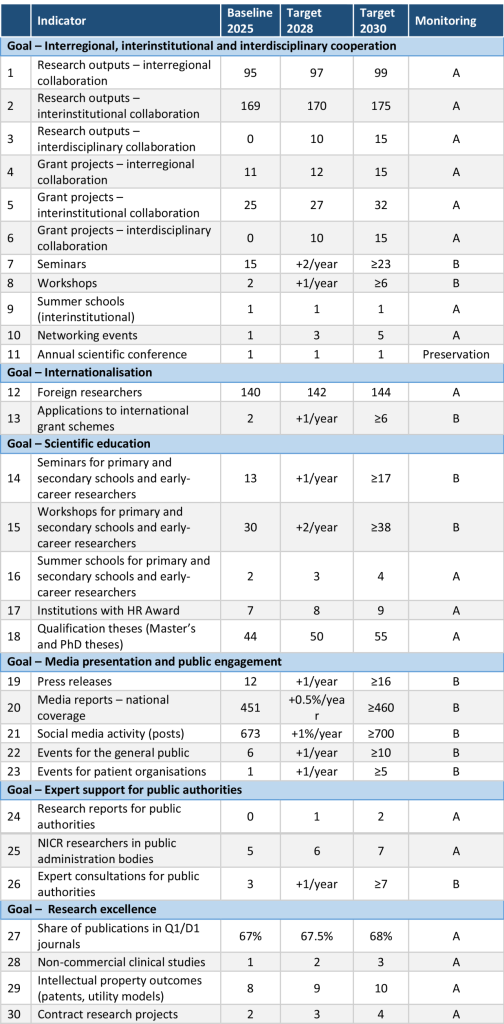
Note: A – monitored at mid-term and at the end of the project; B – monitored as a year-on-year change.