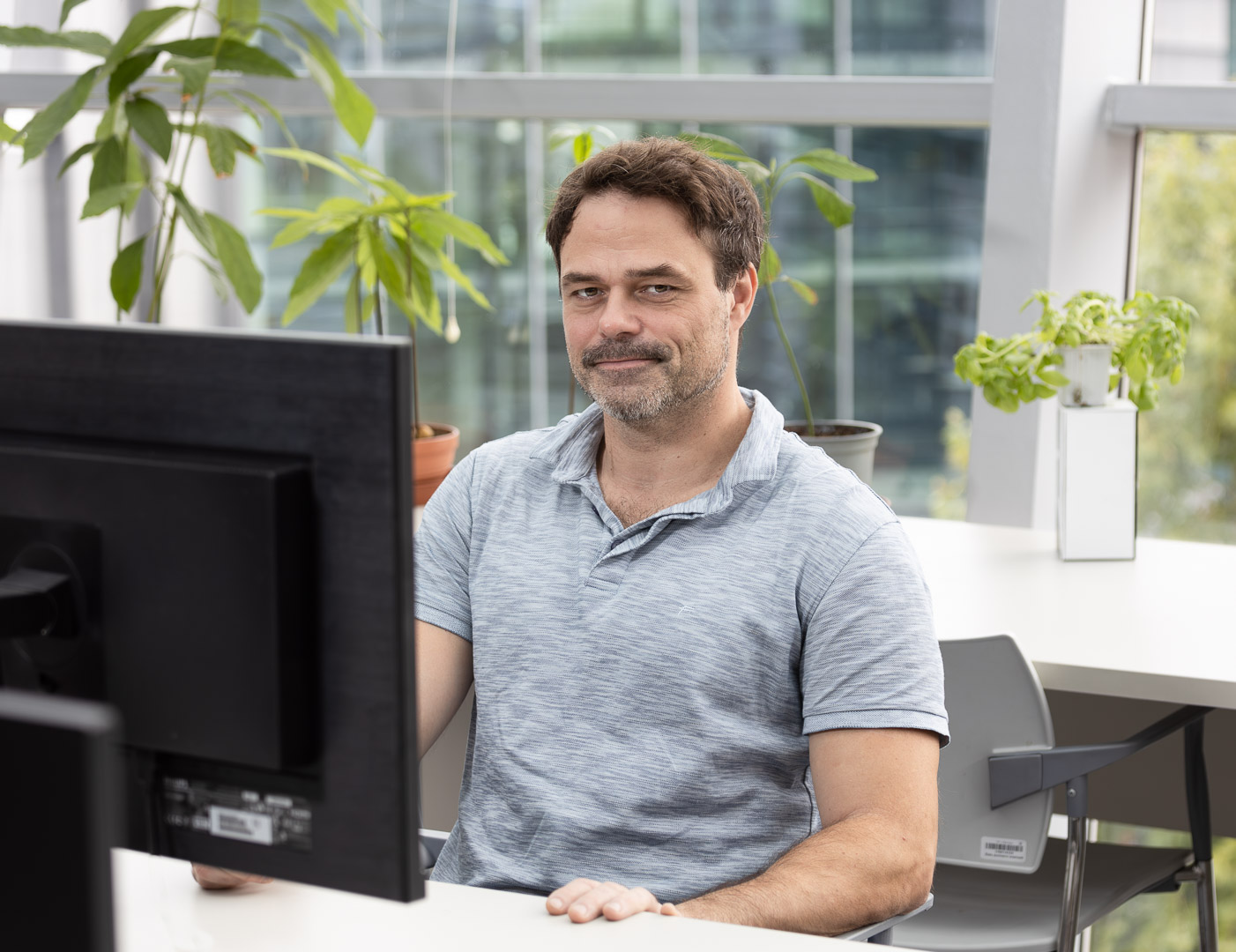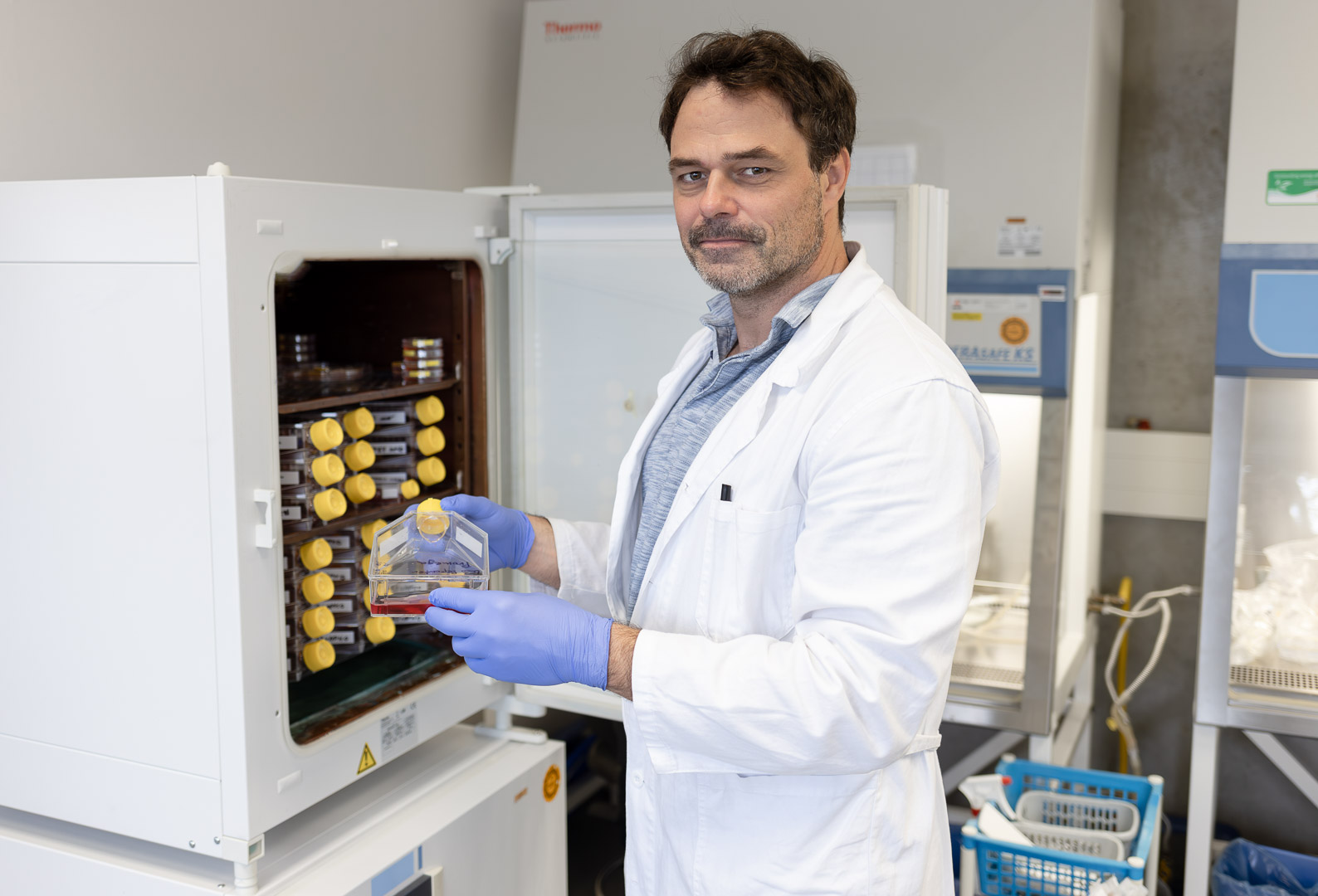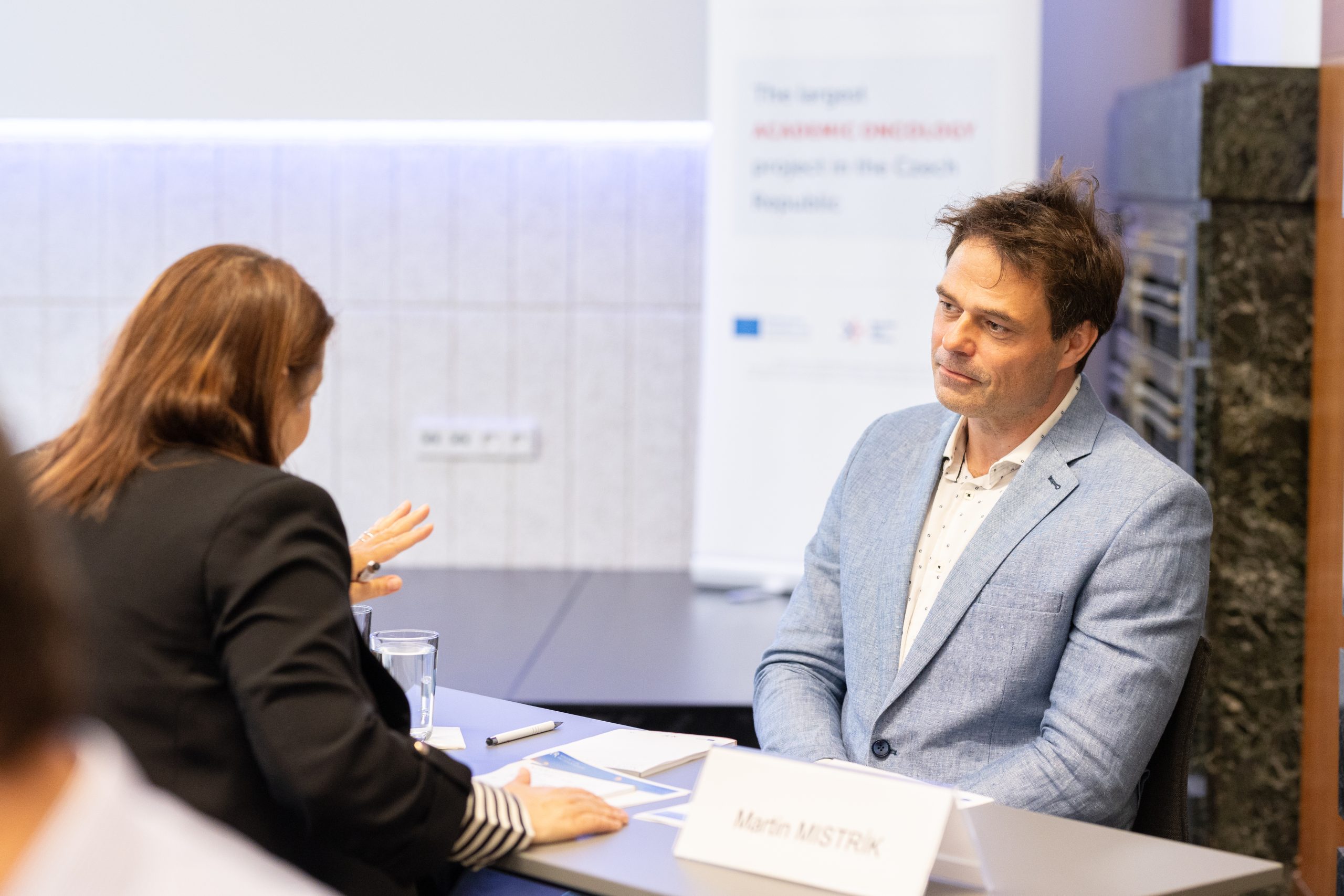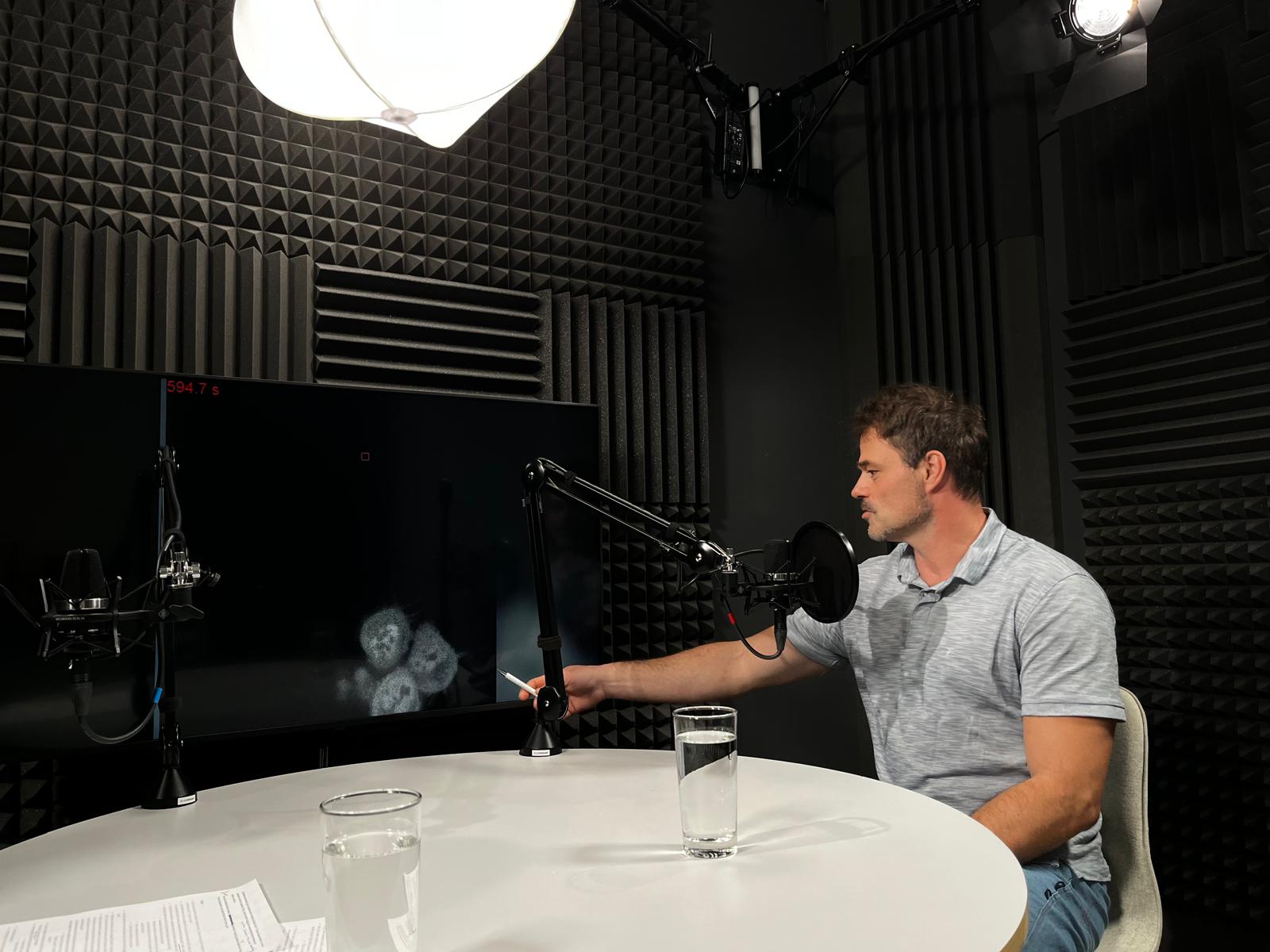



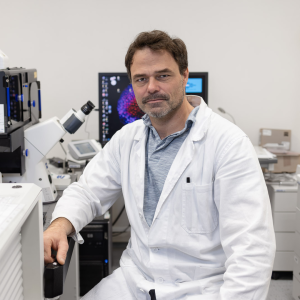
‘Tumour cells are even on their own a rather irritated and stressed system and if you poke them in just the right way, then – just like a really cross choleric person – they will start making mistakes incompatible with their survival’, says Martin Mistrík, head of Laboratory of genome integrity at the Institute of Molecular and Translational Medicine of Palacky University and University Hospital Olomouc. His research team focuses on identifying the mechanisms of cellular stress, replication, and DNA repairs, and investigates how errors in these processes in cancer cells could be used in therapy. He explains why stress adaptation mechanisms could be the Achilles heel of cancer cells, how complex is the journey from basic research to clinical practice, and why trust among research teams is so crucial for the future of Czech science. He also considers the importance of being able to talk about complex biological processes in ways which are clear – and sometimes even a little playful.
-
In your presentations, you seem to be able to explain complex biological processes very clearly and so that it is easy to understand – for instance, you call cancer cells ‘cellular anarchists’. Has the popularising dimension of science always been important for you?
Yes, although I actually arrived at it gradually. I used to live in my ‘small scientific world’, meaning the classic picture of two scientists talking to each other in ways which people without the knowledge of context basically cannot understand.
Since I started tutoring students, however, I started seeing it differently. It made me consider much more the social and educational dimension of what I do. Teaching forces me to formulate thoughts understandably, sometimes even a bit playfully. Metaphors such as ‘cellular anarchists’ are something I use when I try to simplify reality. The fact is, though, that tumour cells pay no attention to rules which normal cells do observe, so in that sense they really are ‘cellular anarchists’.
-
Has there been in your career a moment or meeting that crucially pushed you towards engagement in top-level research?
In 2005, I managed to get to a top lab in Copenhagen, where in the end I stayed for three years. I was surrounded by wonderful people – basically everyone was a scientist of international renown. Some of them were moreover great people and we stayed in touch. It is hard to tell whether there was any one moment. It was rather a combination of the environment and the people. But if I were to name one person who influenced me the most, it would be Jiří Bártek, who was the head of the Danish laboratory.
-
What brought you to the study of tumour cells and genome integrity, which is what your team focuses on?
It was largely given by the environment I was starting in, where it was the main focus of research. I remember I had a colleague there who took it really personally: her father had died of brain cancer, and she saw the work almost like battle against evil. For me, it was more like a natural outcome of interest in biology and partly also physics. Already as a child I had a microscope after my grandfather – I still have it – and was fascinated by observing things we cannot usually see. So, initially, there was the joy of discovering. Gradually, this was joined by a realisation that what I do has important clinical impact, that is, by a motivation which I initially did not have.
-
You often talk about ‘weaknesses of tumour cells’. In your view, in what respects are tumour cells most vulnerable compared to healthy cells?
In one word: stress. For a normal cell to turn into a tumour cell, it must discard a whole range of regulatory mechanisms. But those mechanisms are also important for a correct functioning of key processes such as DNA replication and repairs, maintenance of proteins, or metabolism.
That is why tumour cells suffer from permanent stress: replicatory, genotoxic, proteotoxic, and metabolic. To survive at all, they often function at the very edge of their capacity of coping with these stresses. In other words, they have less reserves to cope with further stressors. All it takes then is another insult, such as gamma radiation or disruption of adaptation mechanisms (for instance via drugs that block DNA repair of protein maintenance), and tumour cells simply cannot cope.
-
So, you observe how cells cope (or not) with various forms of stress. Does your basic strategy, which you describe using the military principle ‘If your opponent is of choleric temper, seek to irritate him’ actually hold?
Yes, in this well-known quotation from the Art of War, choleric temperament is viewed as a weakness that can be used in battle. Unlike healthy cells, a tumour cells is inherently a rather ‘irritated and stressed system’ – and just like when you start stressing a choleric person, it eventually starts making mistakes which are incompatible with its further survival or progression.
-
In what ways could research into cellular stress change cancer treatment? Where do you see the greatest potential for actual clinical impact of your research?
I think there is a great potential in combinatoric approaches. Cellular stress can be modulated in various ways – physically (e.g., by heat), chemically, or biologically. If we suitably combine these approaches with existing therapies, we could significantly increase their effectiveness. What is also important is identification of new biomarkers that would help us predict tumours’ sensitivity to these strategies.
-
Some time ago, people have talked about the results of your research of disulphiram, a drug used to treat alcohol dependence. What did you learn during that work about connecting the results of your basic research with their translation?
It showed me how complex the journey from a discovery to clinical application is. Even if there is a very strong underlying biological reason and we have at our disposal an already approved drug, translation still requires robust pre-clinical data, suitable formulation, a regulatory framework, and close collaboration with the clinical sphere.
Nevertheless, it seems that repurposing of existing drugs can be a highly effective translational strategy. The full process of development of a new drug nowadays takes ten to fifteen years and costs over one billion dollars. Interesting in this context is a comparison with historical discoveries: for instance, when Frederick Banting and Charles Best, together with John Macleod, came up in the early 1920s with the hypothesis that a substance from pancreas could treat diabetes, they were treating patients with insulin in just two years. Currently, this is due to regulation and safety concerns, something like that is unimaginable.
-
How close (or far) is Czech academic research in general currently from being able to actually translate such discoveries into clinical practice?
In my view, Czech science has very strong basic research. We also have great infrastructures and lots of state-of-the-art equipment. For instance, Czech-BioImaging, a national infrastructure whose Olomouc node I am heading, has instruments which many colleagues in the West really envy us, but when it comes to applied research, implementation of discoveries, and technology transfer, we still have a lot of catching up to do. Unfortunately, these things are what translational research largely depends on. So, there is still a lot to catch up on.
-
During the NICR project, you have habilitated: what did it mean for you, professionally and personally?
Certainly, an important milestone. Moreover, it forced me take a stock of all my previous research and teaching efforts, which was very valuable. That is where I see the greatest contribution of the process. Otherwise, I see it more as a sort of formal recognition of long-term work.
-
NICR is moving to a stage where its future is being discussed – how do you, personally, see its sustainability and further development?
I believe NICR has a great potential to become a platform that effectively links experts from basic and translational research in the Czech Republic. Science is nowadays increasingly based on collaboration of specialised teams and yet, paradoxically, before the establishment of NICR international links were often stronger than the domestic ones.
At the first sight, this may look like an advantage, to collaborate mainly with international partners. On the other hand, it is a bit like building a house from the roof. If we want to succeed in the long term, we do need a strong multidisciplinary foundation also on the national level. This has moreover some crucial logistical advantages – it enables both more efficient collaboration and faster implementation of results in practice.
-
What do you think should remain of NICR in the long run?
Especially the interconnections between human resources and infrastructures – and ideally not only on a formal but also on personal, even friendly, level. I am convinced that trust and natural collaboration among people are the most valuable thing such project can bring.
-
You often talk about the importance of early screening: why do you think it is still so difficult to convince people to get preventive check-ups?
It is a combination of psychological and practical factors. People tend to postpone unpleasant things, especially if they have no symptoms. On top of that, there is still insufficient general awareness of the importance of prevention. And yet, early diagnosis is one of the most effective tools of lowering cancer mortality. To put it plainly: it is way better to deal with a small problem on time than try to tackle a big problem later. In many cases, if a tumour is found on time, the solution is relatively simple – and a person can live free of the disease for a long time.